I have always wanted to do a Return on Investment (ROI) calculation on the Chevy Volt but was lacking details into the charging power required to replenish the batteries but now that has been provided to me. See the following quotes from the Chevrolet Volt website (emphasis mine).
“First, the Volt gets an EPA-estimated 35 miles of EV range, and we estimate you can get between 25 – 50 miles of range depending on the three T’s: the outside Temperature, the road Terrain (flat vs. hilly) and your driving Technique. “
“Next, you need to charge that battery. Yes, the Volt has a 16 kWh battery, but what you might not know is only 12.9 kWh is used for charging and driving – this is done to extend battery life. 9.6 kWh is used to propel the car and accessories and 3.3kWh is used in the charging process The average cost of electricity in the U.S. is $.12/kWh, so, take $.12 x 12.9 to get a cost to charge of $1.55, a far cry from the $18.56 to charge that I’ve seen some say online. “
So there are two key parameters that I need to perform an ROI to see if the higher initial cost of the Volt outweighs gas purchases over the typical lifetime of a gas powered car – 1) Average range of the battery life is 35 miles and 2) The Volt requires 12.9 kWh to charge the battery.
In South Carolina, I pay around $0.11/kWh so I’ll make the ROI calculations even more favorable for the Volt and use that cost versus the $0.12/kWh that is on the Chevy website.
The average retail cost of a 2012 Volt is $38,000 and the average cost of a comparable car; say the Volkswagen Jetta is $20,000. I am using a Jetta because it has a similar body style and because I have owned one since 2003 so I’m very familiar with its gas mileage which happens to be 26 Miles per Gallon (MPG).
Let’s assume that someone works 50 weeks out of the year (5 days a week) and has a one way commute to work of 15 miles. This will get us under the average 35 mile limit of the Volt before requiring a recharge of the battery and will avoid having to pay electricity charges twice per day (charging it up at work) for longer commutes.
I’ll initially assume gas is $4.00 per gallon but later I’ll do another calculation at a much higher price.
The calculations based on all the above information is shown below and note that I didn’t account for depreciation or inflation in this calculation (simple payback).
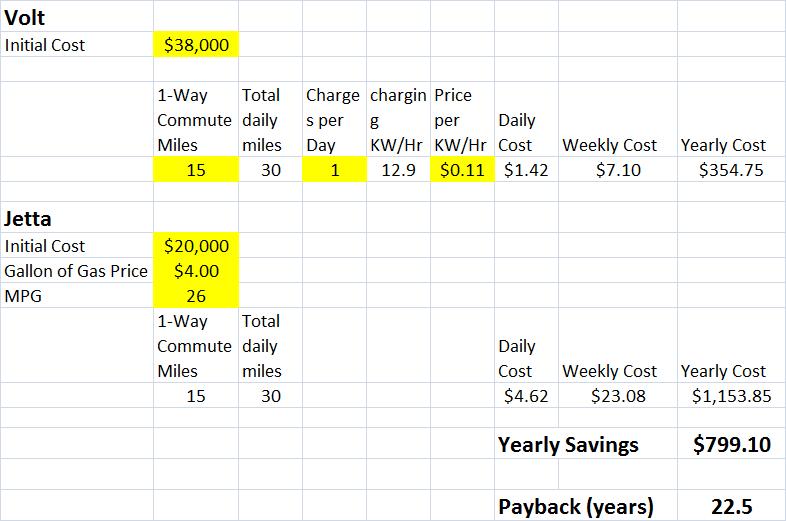
The daily cost of operating a Volt is much lower than the daily cost of operating a Jetta ($1.42 vs. $4.62) but due to the extra $18,000 we had to pay for the Volt we’ll have to drive the Volt for over 22 years to get our money back. Well that sucks! There is no way the car will last for 22 years but what if we double the daily commute and that would double gas prices for the Jetta and double the electricity costs for the Volt but should reduce the ROI.
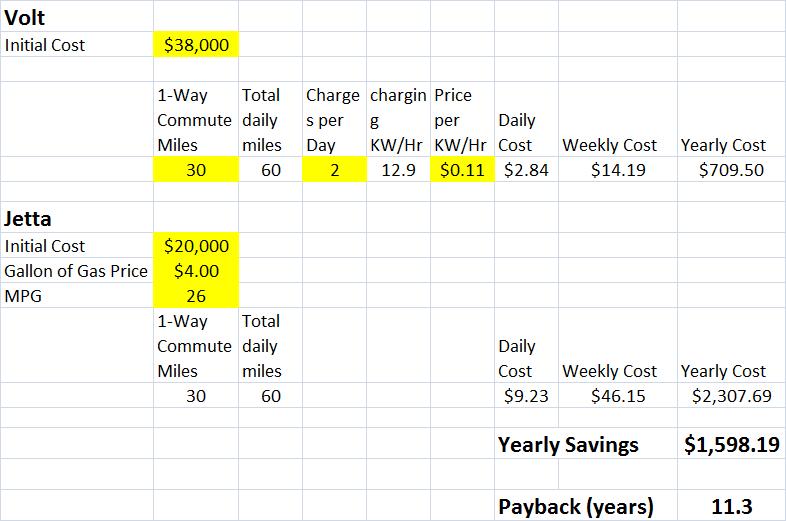
As would be expected, the ROI did drop but you’d still have to drive the Volt for over 11 years to recoup the costs. This is still not likely.
Now let’s see what it would take to recoup our costs in say 5 years (a typical period one owns a car). Let’s keep the one way commute at 30 miles and then raise the gas price per gallon to get an ROI of 5 years.
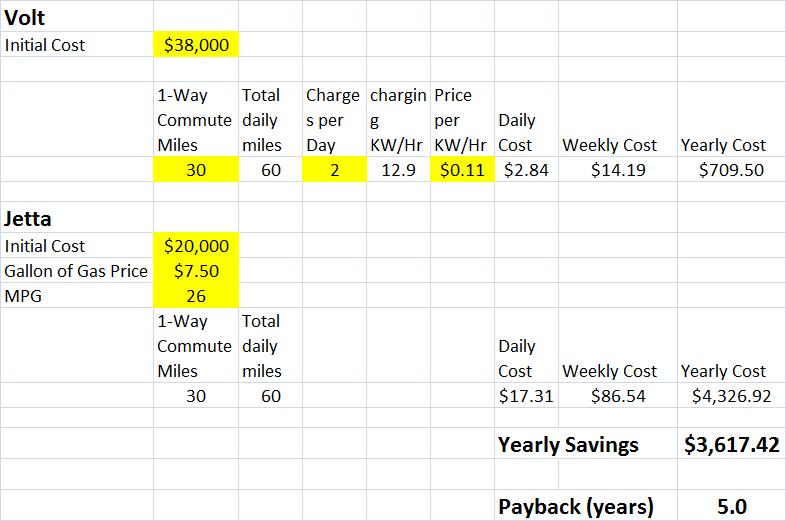
Gas prices would have to sky rocket to $7.50 per gallon before a Volt makes financial sense. It gets worse when you consider depreciation/inflation and this site showed that gas prices must equal $12.50 per gallon before the Volt is competitive.
“And even with rising gasoline prices — topping $4 a gallon in parts of the country — EVs are just not competitive, according to the Lundberg Survey. Gasoline prices would have to rise to $8.53 a gallon to make the Leaf competitive and hit $12.50 for a Volt to be worth it, based on the cost of gasoline versus electricity, fuel efficiency and depreciation, the survey said.”
But what about the Environment? Leftists like to say that using a Volt reduces the burning of fossil fuels and prevents Global Warming. Where do you Greenies think the electricity comes from that charges the Volt? 75% comes from fossil fuels (spreadsheet here-do the math). And do we really have a manmade global warming problem? No.
So even if you over look the fact that the car battery catches on fire, there is still no realistic financial or environmental reason to purchase one of these money pits. It’s a good thing this catastrophe wasn’t developed and manufactured on tax payer dollars. Oh wait!
As a thank you for visiting this site and reading this post, here is a great video on the Chevy Volt that will hopefully ease the pain of knowing our tax dollars were poured down a large hole in the ground.
ADDENDUM (27-MAR-12)
There was a request in the comments section for a more detailed analysis and I’m happy to accommodate. My intentions were to show how one could easily show how a Volt didn’t make economic sense but apparently some Volt lovers couldn’t accept that. So here’s more detail.
I deducted $7,500 for the tax rebate (which I think should be eliminated and most likely will next year) but I also made another modifications to make it more realistic. What makes the Volt unique is the fact that it has a 12 gallon gas tank that it uses to recharge the batteries during driving and that 12 gallons can last as long as 375 miles to 640 miles. You still need to charge it up once a day (at least) but in driving more than 30 miles per day (what most Americans do) you’ll need to use the gas to recharge on the go.
I’ll use the higher estimate (640 miles per fill up) to present the best case for the Volt. I’ll also use 60 miles per day for 5 days per week which works out to about 15,000 miles a year which is the average amount driven in the US.
The estimate below is basically the same as the middle one above but deducting for the tax rebate and adding yearly fuel cost to support 23.44 tank fill ups (15,000 / 640) of 12 gallons each at $4.00 per gallon. It still takes over 10 years to get your ROI.

There is also a great post in Tree Hugger (hardly a Right Wing web site) that states the payback for a Volt when compared to a Camaro is 16.6 years. So, I think I’m being very generous in my calculations here for the Volt. It realy is unjustifiable at current costs.